| |
Learning Paths / Short Theoretical Introduction / Preference Independence
3.7 Preference Independence
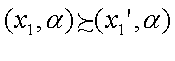
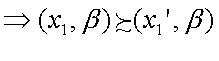
Thus, if the attribute X is preferentially independent of the attribute Y, preferences for specific outcomes of X do not depend on the level of the attribute Y.
Consider the following example.
A person is making a decision about moving to a new house and buying a new car. Let the attribute X denote the location of the new house, and the attribute Y denote the make of the car. The possible values of the attributes are
X: {x1=Helsinki, x2=a dessert in Africa}
|
Y: {y1=Ferrari, y2=Jeep}
|
Suppose
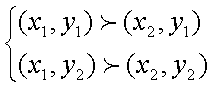 | ( 2.6.3) |
That is, Helsinki is always preferred to Africa, irrespective of the car in question.
However, it may well be that
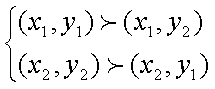 | ( 2.6.4) |
indicating that the person prefers the Ferrari if the new house is in Helsinki, but if the new house is in Africa she considers the Jeep as a better option.
If (3) and (4) hold, X is preferentially independent of the attribute Y, but Y is not preferentially independent of the attribute X. Thus, the attributes are not mutually preferentially independent.
|
|

 X1
X1


 S={X1
S={X1
 X2
X2
 Decomposition